Tuesday - March 25, 2025

Weber Baker

READING


The proper study of Man is anything but Man; and the most improper job of any man, even saints (who at any rate were at least unwilling to take it on), is bossing other men. Not one in a million is fit for it, and least of all those who seek the opportunity. -J.R.R. Tolkien from The Tolkien Letters


WORDS OF HOPE


Today is Tolkien reading day. Most of us were familiar with his works are probably thinking of The Hobbit or the Lord of the Rings. Tolkien was a prolific writer and not only wrote fiction, and a contributor to the Oxford English Dictionary but was a great communicator through letters. He was also a devout Roman Catholic.


The above quote from one of his letters caused me to reflect on the life of Jesus and those we think of as Saints. To me the quote above is almost the backwards way of describing the servant leader we think of when we think of Jesus. Of course Jesus didn’t really need to study humankind; he was well aware from the beginning of the nature of humanity. He does not want to boss his followers around, though he did ask them to do things. And he didn’t particularly seem to seek the opportunity, but by his very nature attracted people to himself.


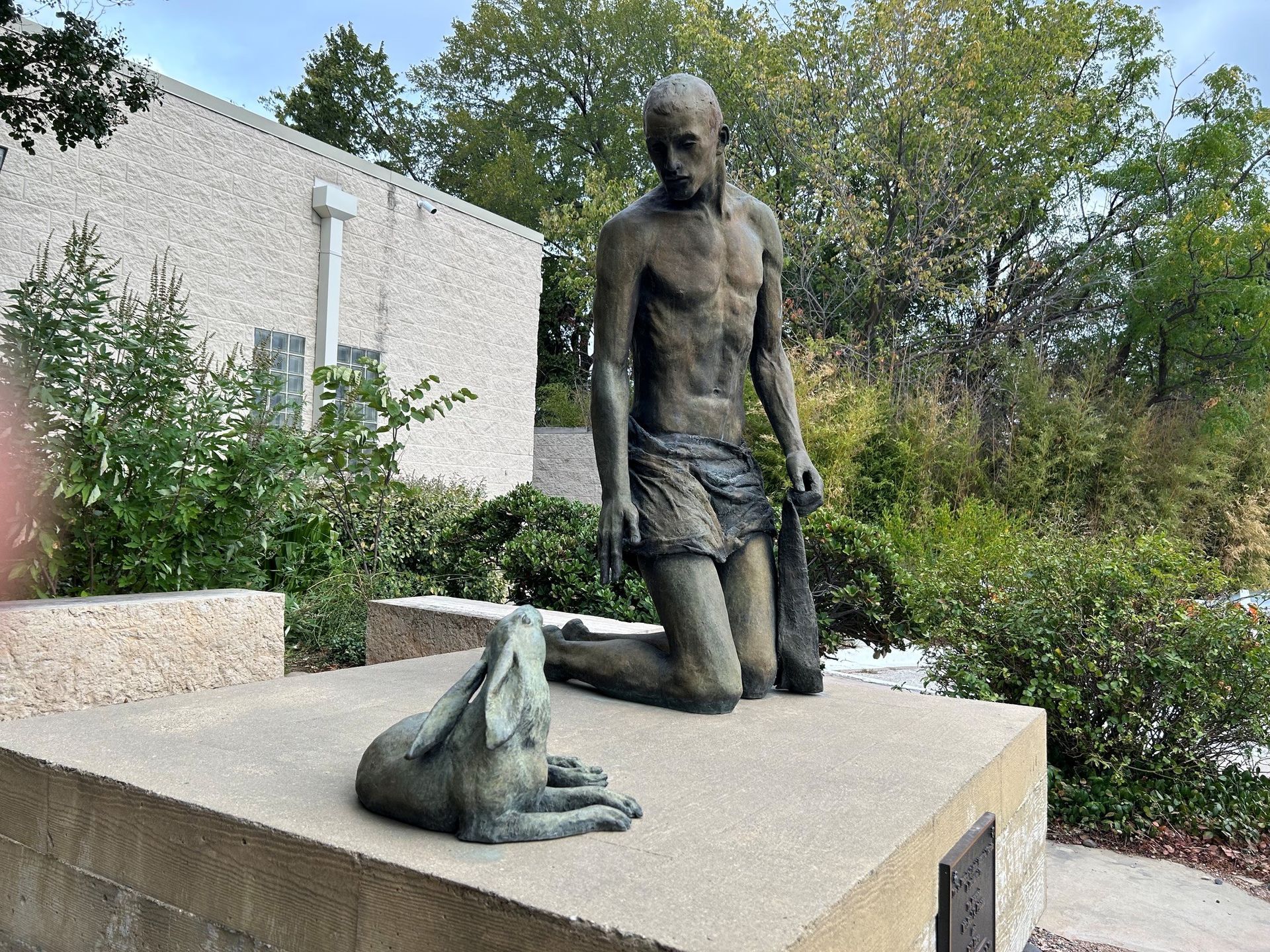
But I am also reminded of a story from the life of Saint Francis. It was a time when Francis actually bossed someone around. One of Francis’s followers, Brother Rufino, was ordered to go preach. Although Rufino came from one of the most prominent families in Assisi, he asked to be excused as he did not see himself as one to stand in front of a crowd. Francis became upset and told Rufino that not only would he preach, but he would preach naked as he had come into the world. Rufino obeyed and went into the pulpit in the Assisi without clothes. The congregation began to laugh at him. In the meantime, Francis began to reconsider what he had done. Reflecting on Rufino’s quick obedience, the second time, and on the fact that he had asked the son of one of the most prominent families in town to stand naked before everyone, Francis stripped naked, went to the pulpit where Rufino was and began to preach so marvelously, even though he was without clothes, that people in the congregation began to weep.


In rereading the story of Saint Francis in light of Tolkien’s statement, I almost wondered if that story was something that influenced Tolkien. Tolkien is not deriding leadership; he is demeaning being a boss, a power seeking control freak. I’m certain most of us can think back to people who we called our bosses. Some of them were bosses; some of them were servant leaders. At least I hope you can say that; fortunately, I can.


So, in your reflection time today, think back to those who were “in charge” over you. Think about the lessons you can learn both from the bosses and from the servant leaders. Reflect back on the life of Jesus and this story of Saint Francis. And keep them in mind whenever you find yourself thrust into a position of leadership.


PRAYER


Gracious God, you have given us examples through Jesus, and those holy people you have sent to be examples to us in our lives. Help us to always live up to these. May we always strive to be servants; and when we are called upon to be servant leaders.


DEVOTION AUTHOR

Weber Baker

Order of Saint Francis and Saint Clare. 


Need Some Inspiration? Read our Daily Devotions

By Kris Baker February 24, 2026
SCRIPTURE  Psalm 30:11 You have turned for me my mourning into dancing; you have loosed my sackcloth and clothed me with gladness. WORDS OF HOPE We are at the beginning of our Lenten journey, forty days during which our responsibility as Christians is to turn toward our God, leaving behind those things that hinder and distract us from our relationship with God. This is a season to undertake practices such as prayer, fasting, study, meditation, and denial of those things that separate us from God and our church. The reward for having kept a Holy Lent is receiving fully the joy of the Resurrection on Easter Sunday. Lent is often seen as a dark and depressing time in the church year. And yet, it is the season in which we are allowed, even encouraged, to be somewhat self-centered. It is the time for us to focus on our personal relationship with God. Lent is the time when we make right our hearts and minds so that we can continue faithfully to do the work of the church. The personal work that we must each undertake during these forty days can be difficult, but it also brings profound joy. What better thing is there for our spirit than the joy that comes from making right our relationship with the Holy One? The verse above from Psalm 30 describes what happens to us as we make our way through Lent. Sackcloth was a scratchy uncomfortable fabric made with either camel or goat hair. It was worn by those who were mourning or who were showing repentance before God. Though we don’t see people walking around in sackcloth, we do hear people talking about or even visibly wearing the misery of turning away from things they have “given up” for Lent. God will turn that discomfort into gladness. We may also mourn some things that we have to remove from our life because they compromise our relationship with God. Here too, our mourning of the loss of worldly things is turned into a joyful dance celebrating God as our dance partner. This brings to my mind the Shaker hymn, “The Lord of the Dance,” written by Sydney Carter in 1963. He bases this hymn on the older Shaker tune, “Simple Gifts,” written in 1848. Carter’s lyrics are Jesus’s version of “dancing through life.” Jesus dances in the joyful times, but he also dances through his darkest hours. He desires that we have the strength to do their same…with him as our dance partner. As today’s prayer, I share Sydney Carter’s lyrics. The words alone are powerful, but I encourage you to listen to the music…and to dance. PRAYER “Dance, then, wherever you may be, I am the Lord of the Dance,” said he. PRAYER I danced in the morning When the world was begun, And I danced in the moon And the stars and the sun, And I came down from heaven And I danced on the earth, At Bethlehem I had my birth. REFRAIN: Dance, then, wherever you may be, I am the Lord of the Dance, said he, And I'll lead you all, wherever you may be, And I'll lead you all in the Dance, said he I danced for the scribe And the pharisee, But they would not dance And they wouldn't follow me. I danced for the fishermen, For James and John They came with me And the Dance went on. REFRAIN I danced on the Sabbath And I cured the lame; The holy people Said it was a shame. They whipped and they stripped And they hung me on high, And they left me there On a Cross to die. REFRAIN I danced on a Friday When the sky turned black It's hard to dance With the devil on your back. They buried my body And they thought I'd gone, But I am the Dance, And I still go on. REFRAIN They cut me down And I leapt up high; I am the life That'll never, never die; I'll live in you If you'll live in me - I am the Lord Of the Dance, said he. YouTube : https://www.youtube.com/watch?v=S8c3-GMOs10 DEVOTION AUTHOR Kris Baker Order of Saint Francis and Saint Clare
By Donald (Luke) Day February 23, 2026
READING  Lord God, as I light this small votive candle, may it be light from you. From an old Franciscan votive prayer. WORDS OF HOPE Many of us light a lot of candles and offer many reflective prayers during the Lenten Season. Today’s reflective reading is from an old prayer which I discovered several years ago when I lived as a Franciscan brother in San Francisco. Once, while waiting for Sunday worship at the Cathedral, I wandered into a side chapel off from the nave. There, I found a votive candle stand for prayer. On the wall and in the flickering light above the candles, I noticed a framed prayer. It was a copy of a prayer discovered many years before in the Cathedral of Tours, France. Candles or some type of torch or lamp have always been part of the human experience of worship. Being raised as a "nearly candle-less" Baptist, I had almost no experience with the powerful symbolism which candles may have for quieting and focusing the spiritual life. That changed in a dramatic manner when I lived with the Franciscan brothers in Dorset, England. The chapel was an ancient stone barn, dark without windows, and utterly quiet as I was the first brother to arrive for morning prayers. My duty was to light several hanging votive candle lamps, and then sit quietly. In the still quiet and flickering light, I opened my soul to Jesus and we communed in prayer. If you have never experienced meditation and silent reflection before a lighted candle, I suggest you give it a try. Perhaps repeat the words of today’s simple prayer and then wait for God’s inspiration or perhaps consolation. In a small side chapel years ago, I had given fire to the wicks of those candles, and now they symbolized the living and illuminating presence of Christ coming into my soul to speak and guide. In that flickering quiet presence, my soul became like the wick of a small candle and ready to be set aflame by Christ. Today, may your soul be open to receive the flame of Christ's teaching love. PRAYER Lord God, quiet my mind and open wide my heart to receive your words. May they penetrate deeply into my soul and transform my daily life so that I will live in harmony with your desires for me. DEVOTION AUTHOR Donald (Luke) Day Order of St. Francis and St. Clare
By Donna Jackson February 20, 2026
SCRIPTURE  Romans 12:12 Rejoice in hope, be patient in tribulation, be constant in prayer. WORDS OF HOPE There are tons of narratives, verses, and songs about clutching onto hope in times of trials and turmoil. Even the Greek story of opening Pandora’s box which unleashed extraordinary chaos and pain in the world, uncovered a tiny hidden bird who promised there would always be Hope! As a little girl, I met a woman with a very noticeable limp who explained she had endured unthinkable cruelty in a Nazi concentration camp as young child. She said no matter how bad it got; she was determined to live and never give up hope. I will always remember her words. “If you ever lose hope, its because you let it go, no one can take it from you”. I cannot think of a more pertinent need for hope than in these unusual times where unity becomes divided by politics, fear, and control. Rebellion and crime are often started when people lose hope. Scripture suggests we be patient in times of tribulation and remain in constant prayer. Often, I am personally hoping God will swiftly answer our prayers for peace and civility. Sometimes our greatest weapon is hope! When Britain’s legendary leader Winston Churchill was asked what his country’s greatest weapon had been against the Nazi regime of Hitler during World War II, he did not hesitate for a moment. He promptly replied, “It was what England’s greatest weapon has always been – hope.” I have read that a person can live forty days without food, about four days without water, four minutes without air, but only four seconds without hope. Right now, may be the most perfect time to be a messenger of hope with something as simple as a kind word of encouragement. Just offering a positive word of hope might be the thing someone needs most. Maybe we should turn this epidemic of monumental chaos and fear into a “a monumental epidemic” of spreading hope. Who knows, the infusion of passing on hope to loved ones and strangers might begin a circle of hope that keeps everyone’s spirit going! PRAYER Creator God let your promise of hope give us the strength to reassure others of your inclusive love, this day and forever more. Amen DEVOTION AUTHOR Donna Jackson
By Reed Kirkman February 19, 2026
SCRIPTURE  Jonah 3.1 Then the word of Yahweh came to Jonah a second time: “Get up! Go to the great city of Nineveh and preach to them the message I told you to share.” (Full passage: Jonah 3 1-10 (Inclusive Bible) WORDS OF HOPE on Iwo Jima Day Today is Iwo Jima Day. I am too young to know what it truly meant to fight in World War II, especially in its final and most devastating months. I did not land on black volcanic sand beneath a sky filled with fire. I did not carry orders that demanded violence while promising freedom. I did not watch friends disappear in an instant. To claim that understanding would be dishonest. And yet remembrance does not require firsthand experience—it requires humility. It asks us to pause, to honor lives lost, and to sit with the truth of what war takes from the human soul. Remembrance is not meant to glorify war. It is meant to sober us. It confronts us with the cost of violence and reminds us that war always takes more than it gives. On this day, honoring those who suffered and died matters deeply. Their lives should never be reduced to symbols or used to justify future violence. True remembrance resists romanticizing sacrifice and instead calls us to learn from it. But remembrance is never only about the past. It presses into the present. It asks how we will live now. I live in a world shaped by the aftermath of war—a world where violence has not ended but has become easier to justify, easier to ignore, and easier to fund. As I stand in the 21st century, early in 2026, my spirit is drawn not toward militarism, but toward peace. I feel called to resist the normalization of war and to choose the way of nonviolence. I name myself, without apology, as a pacifist. Nonviolence is not weakness; it is moral clarity. Pacifism does not deny suffering or ignore injustice. It refuses to answer harm with more harm. It is the conviction that violence may overpower bodies, but it cannot heal hearts, restore dignity, or build lasting justice. The means we choose to shape the world we create, and peace cannot be born from systems designed to destroy. Nonviolence is not passive or naïve. It is active and demanding. It requires courage to interrupt cycles of retaliation and restraint when vengeance feels justified. It calls for truth-telling, protest, solidarity, and love that refuses to become what it opposes. Nonviolence does not avoid conflict—it seeks to transform it. I embrace the word hippie as a spiritual posture rather than a stereotype. Flower power, for me, is a commitment to peace, justice, and love. My bumper stickers speak those values openly. Hippie beads hang in my car, small reminders that even ordinary spaces can carry intention and witness. My clothing reflects simplicity and a refusal to clothe myself in fear or domination. These are not performances; they are practices—ways of aligning daily life with deeply held convictions. The music of the 1960s counterculture still shapes my imagination. Those songs remind me that love can confront war, that dissent can be faithful, and that choosing peace in a violent world is not foolish—it is necessary. In a culture that treats violence as practical and compassion as unrealistic, choosing gentleness becomes an act of resistance. War’s harm reaches far beyond the battlefield. It displaces families, creates refugees, wounds children, and scars the earth itself. Long after fighting ends, war lingers—in bodies, memories, and systems built on fear. And yet we live in a nation that can always find resources for weapons and conflict, while struggling to care for the unhoused, protect LGBTQIA+ lives, welcome immigrants, or ensure dignity for the vulnerable. This is not just a political problem; it is a spiritual one. What we fund reveals what we value. The story of Jonah reminds me that God is not committed to destruction. Nineveh is spared not through force, but through repentance and the turning away from violence. Mercy interrupts what seems inevitable. The story insists that people and nations can change, and that violence is not the final word. Honoring those who fought and died at Iwo Jima does not require glorifying war. True remembrance asks whether we are willing to choose another way. To remember faithfully is to commit ourselves to peace. To grieve honestly is to refuse to make violence sacred. And to follow the God of mercy is to believe that nonviolence is not a dream for another world, but a calling for this one. PRAYER God of peace, come into our wounded world. Where war is normalized, teach us repentance. Where violence is justified, awaken compassion. Where fear governs decisions, plant courage rooted in love. Shape us into people who choose nonviolence, who resist empire without becoming what we oppose, who carry peace in our words, our bodies, our cars, our homes, and our daily lives. Let peace begin in us, and let it ripple outward— into our communities, our nations, and our world. Amen. DEVOTION AUTHOR Reed Kirkman
By Hardy Haberman February 18, 2026
SCRIPTURE  Isaiah 51:1 Listen to me, you who pursue righteousness, you who seek the Lord. Look to the rock from which you were hewn and to the quarry from which you were dug. WORDS OF HOPE Knowing where I came from is important, especially in my faith journey. Isaiah speaks of the “rock from which we were hewn” and in my case I feel that is my history being raised as a Jew. My family were Reform Jews. We didn’t keep Kosher and our brand of Judaism was what we would call Progressive today. My mother was raised Christian and she converted when she married my father. She did her best to become a Jewish Mother, sometimes almost stereotypically so. But, the unique blending of faiths gave me a surprisingly strong foundation to build on. What I tell people now is that since converting to Christianity and joining Cathedral of Hope I have become a better Jew. What I mean is, Jesus was teaching Judaism. He was a Jew. He is often referred to as “rabbi” in scripture if you are looking for proof. Jesus was the first progressive Jew, and that’s why his teachings resonate with me so strongly. As I head into the Lenten season, the ashes on my forehead remind me of the quarry from which I was dug and the dust which someday I will again become. It is not a bad thing to know our impermanence. It reminds us of that which is eternal and something that transcends all divisions and descriptions. PRAYER May we build our faith on a strong foundation and understand that God’s grace will support us in whatever we do. DEVOTION AUTHOR Hardy Haberman
By Jonathon McClellan February 17, 2026
SCRIPTURE Galatians 3.28 There is neither Jew nor Gentile, neither slave nor free, nor is there male and female, for you are all one in Christ Jesus. WORDS OF HOPE Understanding On this Black History Month, we see a lot of division in our country, but we also are experiencing a time of quest for unity. If humanity is to come together, then it will be with the effort of humble people who try to understand one another. When you try to understand others, those same people will try to understand you. Most friendships that last happen because of the effort that was put into the relationships. Whatever you give is what you eventually get back. Someone who seeks to understand you is that much more likely to get your understanding than someone who shows little interest in your thoughts and feelings. The many who spend their lifetime trying to be understood often never get anywhere because if everyone is speaking at the same time, then there is no one listening. Wanting to be understood is not bad, but if your happiness depends on another’s approval, then what will you do when they criticize you? There are great people who are never understood in their own lifetime, and after they are re-discovered by the next generation, are spoken very highly of. The more you are able to understand others, the more you’ll be able to speak to your generation. Being understanding is not about what you know as much as it is about your attitude. By listening often, you show that you value others and teach others to do the same. It is extremely lonely when no one around you understands you, but it is not something you can force. If you never listen to others, then who will listen to you? Listening is not just about being silent; listening in making an effort to see what the other person is seeing. It does not mean that you must always agree or never have something to say. Instead, show that you care. This may mean that you have to wait a while to be understood, but don’t give up hoping that you will be one day. You may find only one person who truly understands you and you’ll be doing better than some great people who never found anyone who was able to. Always remember, God understands you, and you never have to go far to find God. PRAYER All knowing One, You are not understood by many, and yet, You love us. Help us to be as patient. When we are overlooked and criticized falsely, please remind us of our own worth. Bless You Spirit, because You know who we are. May we feel the love You have for us, and may we be at peace within ourselves. Bless You Jesus, the One who knows what it means to be misunderstood. Amen. DEVOTION AUTHOR  Jonathon McClellan Order of St. Francis and St. Clare
More Posts