Wednesday - January 31, 2024

The Reverend Dr. Neil G. Thomas

SCRIPTURE


Mark 5. 1-20


Jesus Restores a Demon-Possessed Man


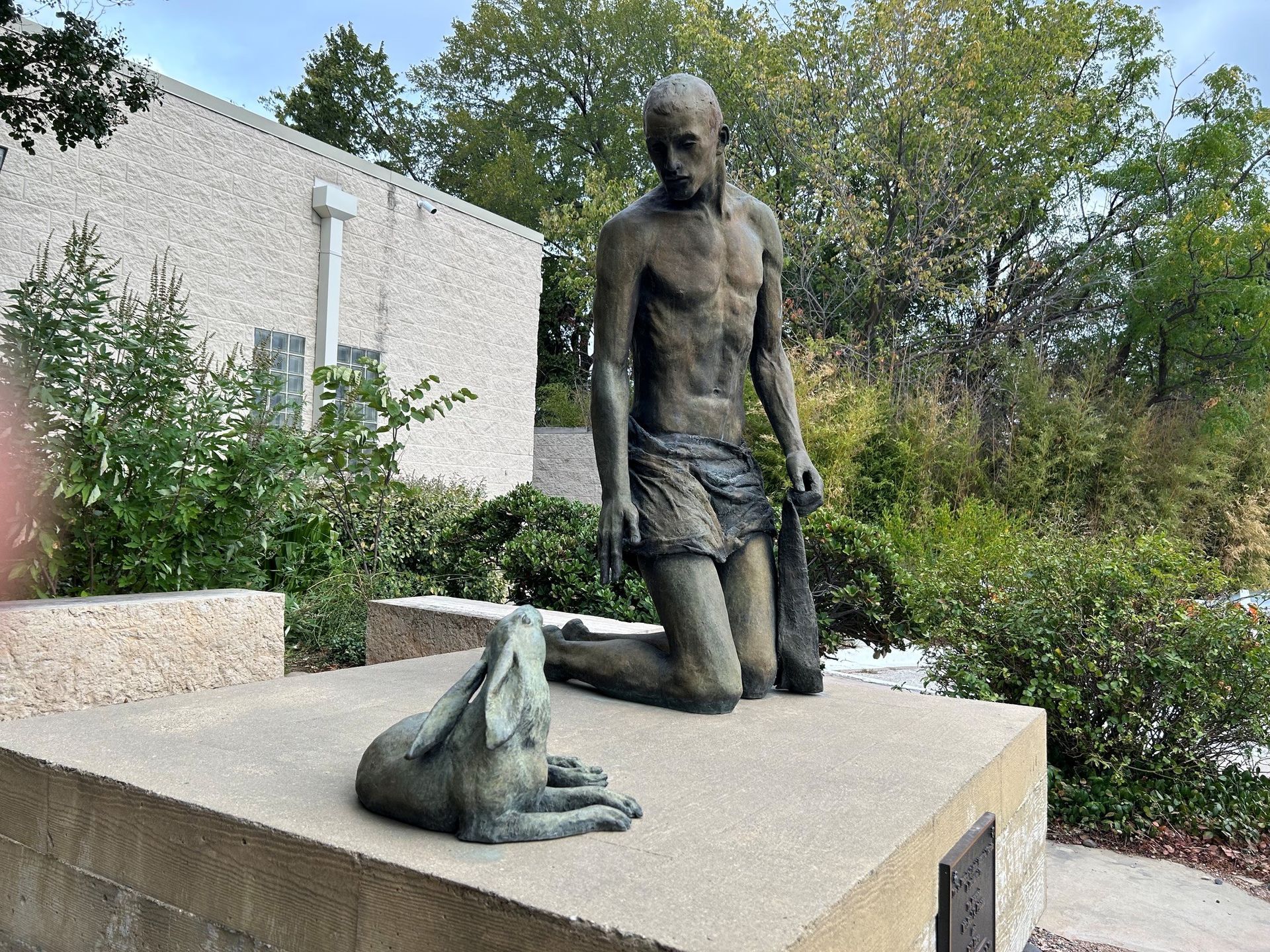
They went across the lake to the region of the Gerasenes. When Jesus got out of the boat, a man with an impure spirit came from the tombs to meet him. This man lived in the tombs, and no one could bind him anymore, not even with a chain. For he had often been chained hand and foot, but he tore the chains apart and broke the irons on his feet. No one was strong enough to subdue him. Night and day among the tombs and in the hills he would cry out and cut himself with stones.


When he saw Jesus from a distance, he ran and fell on his knees in front of him. He shouted at the top of his voice, “What do you want with me, Jesus, Son of the Most High God? In God’s name don’t torture me!” For Jesus had said to him, “Come out of this man, you impure spirit!”


Then Jesus asked him, “What is your name?”


“My name is Legion,” he replied, “for we are many.” And he begged Jesus again and again not to send them out of the area.


A large herd of pigs was feeding on the nearby hillside. The demons begged Jesus, “Send us among the pigs; allow us to go into them.” He gave them permission, and the impure spirits came out and went into the pigs. The herd, about two thousand in number, rushed down the steep bank into the lake and were drowned.


Those tending the pigs ran off and reported this in the town and countryside, and the people went out to see what had happened. When they came to Jesus, they saw the man who had been possessed by the legion of demons, sitting there, dressed and in his right mind; and they were afraid. Those who had seen it told the people what had happened to the demon-possessed man—and told about the pigs as well. Then the people began to plead with Jesus to leave their region.


As Jesus was getting into the boat, the man who had been demon-possessed begged to go with him. Jesus did not let him, but said, “Go home to your own people and tell them how much the Lord has done for you, and how he has had mercy on you.” So the man went away and began to tell in the Decapolis how much Jesus had done for him. And all the people were amazed.


WORDS OF HOPE


At first glance, this scripture seems a little weird. Jesus arrives on the other side of the sea and is confronted by a man who has made his home among the tombs, among the dead. This is his environment and his expectation based of his circumstances and Jesus meets him. Mark says that the man fell to his knees at the sight of Jesus and is confronted by his own question, “What do you want from me?” In the ensuing conversation Jesus offers him freedom from the impure spirits that had tormented him and sends them into surrounding pigs who run off, rushing down a steep bank and into a lake where they are drowned.


Those who witnessed these events, those who saw the impact of Jesus’ encounter with the man were both confused and perhaps frightened, asking Jesus to leave their region. The man is left to witness to his own people just what Jesus had done for him and, with his testimony, the people were amazed.


Of course, as with all Scripture you must be able to contextualize them within the times that they are written. Pigs are not kosher and the book of Deuteronomy states that the Israelites shall not eat their flesh or touch their dead carcass. In their tradition they are unclean, and it is understandable why pigs are used in this miracle.


The bigger story, for me, in this miracle is in the question that the man asks of Jesus, ““What do you want with me, Jesus, Son of the Most High God?” While this is a question from within him, from the “legion”, this is a question that is vital for us all.


We are so often taught a theology of asking God for things. This is not a bad thing. In my daily prayers I often find myself asking God for things, for answers, for other people to be blessed. However, it is less regular that I sit in my own life and ask God to tell me what God wants from me. Is this your story as well?


The more I thought about this today, the more I realized that perhaps, if I spent more time asking God this question, perhaps I would have more clarity for my life and my vocational work.


Believe me, I am grateful to a God who has often rescued me from numerous situations that could lead me on a destructive path or a path that is not beneficial. I am grateful to God who has offered me ways to follow the call that I believe that God has placed in front of me. I am grateful to God who reminds me every day that my everyday actions can make a difference. Today, I am convicted by the question what more can I do for God and what does God want from me.


The conclusion of this story is a testimony to what happens when you are listening to God’s response to our question. For the man in the story, he found wholeness and healing. He found a new life that bore testimony to others, leading them to belief in Jesus.


Friends, our story is a testimony for others and Jesus calls us to live our story – a story that is still evolving and not yet finished. However, this story has an impact and will help others to see your changed life. This is the miracle.


In the words of one of my favorite hymns, Amazing Grace, “I once was lost but now I’m found.”


May we take a moment, amid our asking God for blessings, to also ask God, “What do you want with me, Jesus, Son of the Most High God?”


PRAYER


God, thank you for your faithfulness toward me, hearing my prayers and responding to my needs. Hear me today, O God, as I ask You – What do you want from me? Amen.


DEVOTION AUTHOR


The Reverend Dr. Neil G. Thomas

Senior Pastor

Pronouns: he/his/him


Need Some Inspiration? Read our Daily Devotions
By Donald (Luke) Day February 23, 2026
READING  Lord God, as I light this small votive candle, may it be light from you. From an old Franciscan votive prayer. WORDS OF HOPE Many of us light a lot of candles and offer many reflective prayers during the Lenten Season. Today’s reflective reading is from an old prayer which I discovered several years ago when I lived as a Franciscan brother in San Francisco. Once, while waiting for Sunday worship at the Cathedral, I wandered into a side chapel off from the nave. There, I found a votive candle stand for prayer. On the wall and in the flickering light above the candles, I noticed a framed prayer. It was a copy of a prayer discovered many years before in the Cathedral of Tours, France. Candles or some type of torch or lamp have always been part of the human experience of worship. Being raised as a "nearly candle-less" Baptist, I had almost no experience with the powerful symbolism which candles may have for quieting and focusing the spiritual life. That changed in a dramatic manner when I lived with the Franciscan brothers in Dorset, England. The chapel was an ancient stone barn, dark without windows, and utterly quiet as I was the first brother to arrive for morning prayers. My duty was to light several hanging votive candle lamps, and then sit quietly. In the still quiet and flickering light, I opened my soul to Jesus and we communed in prayer. If you have never experienced meditation and silent reflection before a lighted candle, I suggest you give it a try. Perhaps repeat the words of today’s simple prayer and then wait for God’s inspiration or perhaps consolation. In a small side chapel years ago, I had given fire to the wicks of those candles, and now they symbolized the living and illuminating presence of Christ coming into my soul to speak and guide. In that flickering quiet presence, my soul became like the wick of a small candle and ready to be set aflame by Christ. Today, may your soul be open to receive the flame of Christ's teaching love. PRAYER Lord God, quiet my mind and open wide my heart to receive your words. May they penetrate deeply into my soul and transform my daily life so that I will live in harmony with your desires for me. DEVOTION AUTHOR Donald (Luke) Day Order of St. Francis and St. Clare
By Donna Jackson February 20, 2026
SCRIPTURE  Romans 12:12 Rejoice in hope, be patient in tribulation, be constant in prayer. WORDS OF HOPE There are tons of narratives, verses, and songs about clutching onto hope in times of trials and turmoil. Even the Greek story of opening Pandora’s box which unleashed extraordinary chaos and pain in the world, uncovered a tiny hidden bird who promised there would always be Hope! As a little girl, I met a woman with a very noticeable limp who explained she had endured unthinkable cruelty in a Nazi concentration camp as young child. She said no matter how bad it got; she was determined to live and never give up hope. I will always remember her words. “If you ever lose hope, its because you let it go, no one can take it from you”. I cannot think of a more pertinent need for hope than in these unusual times where unity becomes divided by politics, fear, and control. Rebellion and crime are often started when people lose hope. Scripture suggests we be patient in times of tribulation and remain in constant prayer. Often, I am personally hoping God will swiftly answer our prayers for peace and civility. Sometimes our greatest weapon is hope! When Britain’s legendary leader Winston Churchill was asked what his country’s greatest weapon had been against the Nazi regime of Hitler during World War II, he did not hesitate for a moment. He promptly replied, “It was what England’s greatest weapon has always been – hope.” I have read that a person can live forty days without food, about four days without water, four minutes without air, but only four seconds without hope. Right now, may be the most perfect time to be a messenger of hope with something as simple as a kind word of encouragement. Just offering a positive word of hope might be the thing someone needs most. Maybe we should turn this epidemic of monumental chaos and fear into a “a monumental epidemic” of spreading hope. Who knows, the infusion of passing on hope to loved ones and strangers might begin a circle of hope that keeps everyone’s spirit going! PRAYER Creator God let your promise of hope give us the strength to reassure others of your inclusive love, this day and forever more. Amen DEVOTION AUTHOR Donna Jackson
By Reed Kirkman February 19, 2026
SCRIPTURE  Jonah 3.1 Then the word of Yahweh came to Jonah a second time: “Get up! Go to the great city of Nineveh and preach to them the message I told you to share.” (Full passage: Jonah 3 1-10 (Inclusive Bible) WORDS OF HOPE on Iwo Jima Day Today is Iwo Jima Day. I am too young to know what it truly meant to fight in World War II, especially in its final and most devastating months. I did not land on black volcanic sand beneath a sky filled with fire. I did not carry orders that demanded violence while promising freedom. I did not watch friends disappear in an instant. To claim that understanding would be dishonest. And yet remembrance does not require firsthand experience—it requires humility. It asks us to pause, to honor lives lost, and to sit with the truth of what war takes from the human soul. Remembrance is not meant to glorify war. It is meant to sober us. It confronts us with the cost of violence and reminds us that war always takes more than it gives. On this day, honoring those who suffered and died matters deeply. Their lives should never be reduced to symbols or used to justify future violence. True remembrance resists romanticizing sacrifice and instead calls us to learn from it. But remembrance is never only about the past. It presses into the present. It asks how we will live now. I live in a world shaped by the aftermath of war—a world where violence has not ended but has become easier to justify, easier to ignore, and easier to fund. As I stand in the 21st century, early in 2026, my spirit is drawn not toward militarism, but toward peace. I feel called to resist the normalization of war and to choose the way of nonviolence. I name myself, without apology, as a pacifist. Nonviolence is not weakness; it is moral clarity. Pacifism does not deny suffering or ignore injustice. It refuses to answer harm with more harm. It is the conviction that violence may overpower bodies, but it cannot heal hearts, restore dignity, or build lasting justice. The means we choose to shape the world we create, and peace cannot be born from systems designed to destroy. Nonviolence is not passive or naïve. It is active and demanding. It requires courage to interrupt cycles of retaliation and restraint when vengeance feels justified. It calls for truth-telling, protest, solidarity, and love that refuses to become what it opposes. Nonviolence does not avoid conflict—it seeks to transform it. I embrace the word hippie as a spiritual posture rather than a stereotype. Flower power, for me, is a commitment to peace, justice, and love. My bumper stickers speak those values openly. Hippie beads hang in my car, small reminders that even ordinary spaces can carry intention and witness. My clothing reflects simplicity and a refusal to clothe myself in fear or domination. These are not performances; they are practices—ways of aligning daily life with deeply held convictions. The music of the 1960s counterculture still shapes my imagination. Those songs remind me that love can confront war, that dissent can be faithful, and that choosing peace in a violent world is not foolish—it is necessary. In a culture that treats violence as practical and compassion as unrealistic, choosing gentleness becomes an act of resistance. War’s harm reaches far beyond the battlefield. It displaces families, creates refugees, wounds children, and scars the earth itself. Long after fighting ends, war lingers—in bodies, memories, and systems built on fear. And yet we live in a nation that can always find resources for weapons and conflict, while struggling to care for the unhoused, protect LGBTQIA+ lives, welcome immigrants, or ensure dignity for the vulnerable. This is not just a political problem; it is a spiritual one. What we fund reveals what we value. The story of Jonah reminds me that God is not committed to destruction. Nineveh is spared not through force, but through repentance and the turning away from violence. Mercy interrupts what seems inevitable. The story insists that people and nations can change, and that violence is not the final word. Honoring those who fought and died at Iwo Jima does not require glorifying war. True remembrance asks whether we are willing to choose another way. To remember faithfully is to commit ourselves to peace. To grieve honestly is to refuse to make violence sacred. And to follow the God of mercy is to believe that nonviolence is not a dream for another world, but a calling for this one. PRAYER God of peace, come into our wounded world. Where war is normalized, teach us repentance. Where violence is justified, awaken compassion. Where fear governs decisions, plant courage rooted in love. Shape us into people who choose nonviolence, who resist empire without becoming what we oppose, who carry peace in our words, our bodies, our cars, our homes, and our daily lives. Let peace begin in us, and let it ripple outward— into our communities, our nations, and our world. Amen. DEVOTION AUTHOR Reed Kirkman
By Hardy Haberman February 18, 2026
SCRIPTURE  Isaiah 51:1 Listen to me, you who pursue righteousness, you who seek the Lord. Look to the rock from which you were hewn and to the quarry from which you were dug. WORDS OF HOPE Knowing where I came from is important, especially in my faith journey. Isaiah speaks of the “rock from which we were hewn” and in my case I feel that is my history being raised as a Jew. My family were Reform Jews. We didn’t keep Kosher and our brand of Judaism was what we would call Progressive today. My mother was raised Christian and she converted when she married my father. She did her best to become a Jewish Mother, sometimes almost stereotypically so. But, the unique blending of faiths gave me a surprisingly strong foundation to build on. What I tell people now is that since converting to Christianity and joining Cathedral of Hope I have become a better Jew. What I mean is, Jesus was teaching Judaism. He was a Jew. He is often referred to as “rabbi” in scripture if you are looking for proof. Jesus was the first progressive Jew, and that’s why his teachings resonate with me so strongly. As I head into the Lenten season, the ashes on my forehead remind me of the quarry from which I was dug and the dust which someday I will again become. It is not a bad thing to know our impermanence. It reminds us of that which is eternal and something that transcends all divisions and descriptions. PRAYER May we build our faith on a strong foundation and understand that God’s grace will support us in whatever we do. DEVOTION AUTHOR Hardy Haberman
By Jonathon McClellan February 17, 2026
SCRIPTURE Galatians 3.28 There is neither Jew nor Gentile, neither slave nor free, nor is there male and female, for you are all one in Christ Jesus. WORDS OF HOPE Understanding On this Black History Month, we see a lot of division in our country, but we also are experiencing a time of quest for unity. If humanity is to come together, then it will be with the effort of humble people who try to understand one another. When you try to understand others, those same people will try to understand you. Most friendships that last happen because of the effort that was put into the relationships. Whatever you give is what you eventually get back. Someone who seeks to understand you is that much more likely to get your understanding than someone who shows little interest in your thoughts and feelings. The many who spend their lifetime trying to be understood often never get anywhere because if everyone is speaking at the same time, then there is no one listening. Wanting to be understood is not bad, but if your happiness depends on another’s approval, then what will you do when they criticize you? There are great people who are never understood in their own lifetime, and after they are re-discovered by the next generation, are spoken very highly of. The more you are able to understand others, the more you’ll be able to speak to your generation. Being understanding is not about what you know as much as it is about your attitude. By listening often, you show that you value others and teach others to do the same. It is extremely lonely when no one around you understands you, but it is not something you can force. If you never listen to others, then who will listen to you? Listening is not just about being silent; listening in making an effort to see what the other person is seeing. It does not mean that you must always agree or never have something to say. Instead, show that you care. This may mean that you have to wait a while to be understood, but don’t give up hoping that you will be one day. You may find only one person who truly understands you and you’ll be doing better than some great people who never found anyone who was able to. Always remember, God understands you, and you never have to go far to find God. PRAYER All knowing One, You are not understood by many, and yet, You love us. Help us to be as patient. When we are overlooked and criticized falsely, please remind us of our own worth. Bless You Spirit, because You know who we are. May we feel the love You have for us, and may we be at peace within ourselves. Bless You Jesus, the One who knows what it means to be misunderstood. Amen. DEVOTION AUTHOR  Jonathon McClellan Order of St. Francis and St. Clare
By Thomas Riggs February 16, 2026
SCRIPTURE  Acts 7:33-34 Then the Lord said to him, ‘Take off your sandals, for the place where you are standing is holy ground. I have indeed seen the oppression of my people in Egypt. I have heard their groaning and have come down to set them free. Now come, I will send you back to Egypt. – WORDS OF HOPE In the seventh chapter of the book of Acts, the disciple known as Stephen is brought before the Sanhedrin and made to testify. For the length of the chapter, Stephen tells God’s story of salvation from Abraham to Joseph to Moses, including Moses encounter with God on Mount Sinai. It’s a familiar story to us, especially if you’ve seen Cecil B. DeMille’s Ten Commandments or sang the song We Are Standing on Holy Ground while holding hands at the end of Cathedral of Hope’s worship service. For Black theologians, the concept of Standing on Holy Ground isn’t necessarily reverential or worshipful. For Howard Thurman, James Cone, and other Black theologians, “standing on holy ground” is not a call to retreat from the world, but it is an awakening to God’s presence in the midst of struggle, suffering, and resistance. God says to Moses that she has seen the oppression of Her people in Egypt. He has heard their groaning. They have come down to set the people free. The burning bush appears while Israel groans under Egypt’s whip. For the disinherited, standing on holy ground means reclaiming dignity when the world says you have none. The ground becomes holy, says Howard Thurman, when a person refuses to accept degradation and listens for the divine underneath the noise of oppression. For James Cone, Black suffering in a racist society is precisely where God speaks and acts. Holy ground is slave quarters, jails, protest marches, and halls where truth is spoken to power. The ground is holy because God shows up where pain is real. It’s where God identifies with the oppressed. I have seen them. I have heard them. I am coming to set them free. In the Black church tradition, holy ground is communal and embodied. And you don’t go tippy-toe on it; you testify on it. Shoes come off to acknowledge that God has already claimed this space. God is already present where liberation is being demanded. In these days where Minnesotans toes are freezing, that ice covered sidewalk is holy ground. Wherever Black men and women have stood before the baton and the dogs, that street is holy ground. The question is this: When and where are we being called to stand in solidarity with God, remove our shoes, and stand on holy ground. PRAYER Holy God, you see the suffering of your people and hear every groan, and you make holy the ground where courage, resistance, and hope take root. Open our eyes to recognize your presence in places of struggle, and give us the courage to stand in solidarity, to remove our shoes, and to refuse the lie that any person lacks dignity. Send us, as you sent Moses, to stand where liberation is needed, to testify to your justice, and to walk with you until all your people are free. Amen. DEVOTION AUTHOR Thomas Riggs
More Posts